Thursday, May 22, 2014

Drugs


Our brain is protected by a layer of capillaries called the blood-brain barrier.
The drugs that are small enough to pass through are called psychoactive drugs

Drugs are either….


Agonists
Antagonists
Reuptake inhibitors
If a drug is used often, a tolerance is created for the drug.
Thus you need more of the drug to feel the same effect.
If you stop using a drug you can develop withdrawal symptoms
Stimulants:

Speed up body processes.
More powerful ones (like cocaine) give people feelings of invincibility.

Depressants:

Slows down body processes.
Alcohol
Anxiolytics (barbiturates and tranquilizers)
Alcohol:
More than 86 billion dollars are spent annually on alcoholic beverages. 
Alcohol is involved in 60% of ALL crimes. 
Alcohol is involved in over 70% of sexually related crimes.  
Opiates:
Has depressive and hallucinogenic qualities. 
Agonist for endorphins. 
Derived from poppy plant. 
Morphine, heroin, methadone and codeine. 
All these drugs cross the placental barrier….teratogens.  

States of Unconscious

Sleep

-sleep is a state of consciousness
-we are less aware of our surroundings
  • conscious
  • subconscious
  • unconscious

Why do we daydream?
  • can help us prepare for future events
  • they can nourish our social development
  • can substitute for impulsive behavior
Fantasy Prone Personalities: someone who imagines and recalls experiences with lifelike vividness and who spends considerable time fantasizing.

Biological Rhythms:
-Annual cycles: seasonal variations
-28 day cycles: menstrual cycle
-24 hour cycle: our circadian rhythm
-90 minute cycle: sleep cycles

Circadian Rhythm:
-24 hour biological clock
-body temperature and awareness changes throughout the day.

Sleep Stages:
-5 identified
-takes about 90-100 minutes to pass through 5 stages
-brain's waves will change according to the sleep stage
-first 4 known as NREM
-5th is known as REM sleep

Dreams: a sequence of images, emotions, and thoughts passing through a sleeping person's mind.

Manifest Content: the remembered storyline of a dream.

Latent Content: the underlying meaning of a dream.

Why do we dream?

Freud's Wishful-Fulfillment Theory:
-dreams are the key to understanding our inner conflicts.
-ideas and thoughts tat are hidden in our unconscious

Information-Processing Theory:
-dreams act to sort out and understand the memories that you experience that day
-REM sleep does increase after stressful events.

Activation-Synthesis Theory:
-during the night, out brainstem releases random neural activity, dreams may be a way to make sense of that activity.

Hypnosis: 

Altered state of consciousness?
Posthypnotic suggestion
Posthypnotic amnesia
Dissociation Theory:
Theory by Ernest Hilgard.
We voluntarily divide our consciousness up.
Ice Water Experiment.
We have a hidden observer, a level of us that is always aware.
 
Role Theory:
Hypnosis is NOT an altered state of consciousness.
Different people have various state of hypnotic suggestibility.
A social phenomenon where people want to believe.
Work better on people with richer fantasy lives.
   
State Theory:
Hypnosis is an altered state of consciousness.
Dramatic health benefits
It works for pain best.


Learning

Learning: Long lasting change in behavior due to experience.

Classical Conditioning: 
Ivan Pavlov
Studied Digestion of Dogs.
Dogs would salivate before they were given food (triggered by sounds, lights etc…)
Dogs must have LEARNED to salivate.

This is passive learning (automatic…learner does NOT have to think).
First thing you need is a unconditional relationship.
Unconditional Stimulus (UCS)- something that elicits a natural, reflexive response.
Unconditional Response (UCR)- response to the UCS.
Next you find a neutral stimulus (something that by itself  elicits no response). 
You present the stimulus with the UCS a whole bunch of times. 
After a while, the body begins to link together the neutral stimulus with the UCS.
We know learning takes places when the previously neutral stimulus elicits a response. 
At this point the neutral stimulus is called the conditioned stimulus (CS) and the unconditional response becomes the conditioned response (CR).
 Extinction: the diminishing of a conditioned response, will eventually happen when the UCS does not follow the CS.

Spontaneous Recovery: the reappearance, after a rest period, of an extinguished conditioned response.

Generalization: the tendency, once a response has been conditioned, for stimuli similar to the CS to elicit similar responses.

Discrimination: ability to distinguish between a CS and other stimuli that does not signal UCS.

Operant Conditioning:
-the learner is not passive
-learning based on consequence
- a type of learning in which behavior is strengthened if followed by reinforcement or diminished if followed by punishment

Classical Vs. Operant
-they both use acquisition, discrimination, SR, generalization and extinction.
-Classical (respondent behavior)
-Operant: involves behavior where one can influence their environment with behaviors which have consequences. Who's in control?

The Law of Effect
  • Edward Thorndike: instrumental learning
-Law of effect: rewarded behavior is likely to recur.
  • B.F. Skinner
Shaping: a procedure in O.C. in which reinforces guide behavior closer and closer towards a goal.

Reinforces: event that strengthens the behavior it follows. 
 
Primary Reinforcer: an innately reinforcing stimulus
Conditioned (Secondary) reinforcer: a stimulus that gains it reinforcing power through its association with a primary reinforcer.
Punishment: an event that decreases the behavior that it follows.  


Memory

Memory:
the persistence of learning over time through the storage and retrieval of information.

Memory Process:

  • Encoding
  • Storage
  • Retrieval
Encoding: the processing of information into the memory system.

Storage: the retention of encoded material over time.

Retrieval: the process of getting the information out of memory storage.

Recall Vs. Recognition:

  • with recall- you must retrieve the information from your memory
  • with recognition- you must identify the target from possible targets

Flashbulb Memory: a clear moment of an emotionally significant moment or event.

Types of Memory:
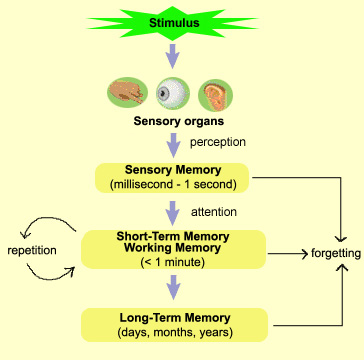
  • Sensory: immediate, initial recording of sensory information stored just for an instant, must get unprocessed.
  • Short-term: memory that holds only a few items (7 digits), the information will be stored into long-term or forgotten.
  • Long-term: relatively permanent and limitless storehouse of the memory syste


Encoding


Automatic Processing:
-unconscious encoding of incidental information
-you encode space, time, and word meaning
-things become automatic with practice

Effortful Processing:
-encoding that requires attention and conscious effort
-rehearsal is the most common effortful processing technique
-through enough rehearsal, what was effortful becomes automatic

the next-in-line effect: we seldom remember what the person has just said or done if we are next.

Spacing Effect:
-we encode better when we study or practice over time.

 Serial Positioning Effect: Our tendency to recall best the last and first items in a list.

Types of Encoding:

  • Semantic Encoding: the encoding of meaning, like the meaning of words.
  • Acoustic Encoding: the encoding of sound, especially the sounds of words.
  • Visual Encoding: the encoding of picture images.
Mnemonic Devices: use imagery, like my "peg word"
Chunking:
-organizing items into familiar, manageable units
-often it will occur automatically

Types of Retrieval Failure:

  • Proactive Interference: the disruptive effect of prior learning on the recall of new information
  • Retroactive Interference: the disruptive effect of new learning on the recall of old information
Misinformation Effect: incorporating misleading information into one's memory of an event.

Sunday, April 20, 2014

Diagrams of the Sensations


Thinking, Language and Thought, and Intelligence

THINKING
concepts are like piaget's idea of schemas
prototypes: best mental image or example of category.
heuristics: rule of them allows to make judgement and solve problems efficiently. shortcut, prone to errors.
fixation: inability to see problems form new perspective.

LANGUAGE AND THOUGHT
phonemes: smallest distinct sound unit in language. ex. syllables
morphemes: smallest unit that carries meanings. ex. suffix

INTELLIGENCE
...

Perception

process of organizing and interpreting information, enabling us to recognize meaningful objects and events.

geslalt philosophy: whole is greater than the sum of its parts.

figure ground relationship: organization of visual field into objects (figures) that stand out from their surrounding (ground).

grouping: perceptual tendency to organize stimuli into groups that we understand. based on proximity, similarity, continuity, and connection.

depth perception: ability to see objects in 3D although the image that strike the retina are 2D allows to judge distance.

binocular cues - retinal disparity: a binocular cue for seeing depth.
closer an object comes to you the greater the disparity is between two image.

monocular cues:
interposition: if something is blocking our view, we perceive it as closer.
relative size: if we know that two objects are similar in size, the one that looks smaller is farther away.
relative clarity: we assume hazy objects are farther away.

texture gradient: the coaser it looks the closer it is.
relative height: things higher in our field of vision, they look farther away.
relative motion: things that are closer appear to move more quickly.
liner perspective: parallel lines seem to converge with distance.
light and shadow: dimmer objects appear farther away because they reflect less light.

motion perception: we perceive motion incredible well/ we judge mostly by the size of the object.

phi phenomenon: allusion of movement created when two or more adjacent lights blink on and off in succession.

perceptual consistency: perceiving objects as unchanging even as illumination and retinal images changes.

Sensation

sensation: your window to the world.
perception: interpreting what comes in your window.

sensation: process by which sensory receptors and nervous system receive stimulus from the environment.

bottom-up vs. top-down processing:
bottom-up: begins with sense receptors and works to the brain integration of the sensory information. (thalamus responses)
top-down: into processing guided by higher level mental process.

absolute threshold: minimum stimulation to detect a stimulus 50% of the time.

difference threshold: minimum difference that a person can detect between 2 stimuli. known as just noticeable difference.

weber's law: idea that to perceive a difference between two stimuli, they must differ by a constant percentage; not a constant amount.

signal detection theory: predicts how we detect a stimuli amid other stimuli. assumes that we do not have absolute threshold, we detect stuff based on experience and motivation.

sensory adaption: decreased responsiveness to stimuli due to constant stimulation.

selective attention: focusing of conscious awareness on a particular stimuli.

cocktail party phenomenon: describes ability to focus one's listening attention on a single talker among a mixture of conversations and background noise, ignoring other conversations. form of selective attention.

vision: most dominating sense. visual capture.
phase 1: gathering light
short waves = higher frequency (bluish color, higher pitched sounds)
long waves = low frequency (reddish wave, low-pitched sounds)
height of wave gives it's intensity (brightness)
length of waves gives it's hue (color)
ROY G BIV
long waves = more red
short waves = more violet

transduction: transforming signals into neural impulses. information goes from senses to thalamus, then various areas in brain.
conversion of one form of energy to another.
stimulus energies to neural impulses.
ex. light energy to vision
chemical to taste and smell. sound waves to sound.

color vision 2 major theory:
young-helmholtz trichromatic (3 color) theory: 3 types of cones.
  • red
  • blue
  • green
these types of cones can make millions of combinations of colors. most color blind people simpy lack cone receptors for one or more of these primary colors.

opponent-process theory: the sensory receptors come in pairs
  • red/green
  • yellow/blue
  • black/white
if one color is stimulated, the other is inhibited.

hearing: we hear sound waves
height of waves gives us amplitude of the sound.
frequency of waves gives the pitch of sound.

transduction in ear: sounds waves hit ear drum then anvil. then hammer. then stirrup then oral window. everything is vibrating. then cochlea vibrates which lined with mucus called basilar membrane and has hair cells.
when hair cells vibrate they turn vibrations into neural impulses which are called organ of corti. sent to the thalamus.

place theory: different hairs vibrate in the cochlea when there are different pitches.
so some hairs vibrate when they hear high pitches and others when they hear low pitches.

frequency theory: all hair vibrate, but at different speeds.

deafness:
conduction deafness: something goes wrong with sound and vibration or the way to cochlea. you can place the bones or get a hearing aid.

nerves (sensorineural) deafness: hair cells in cochlea get damage. loud noises can cause this type of deafness. no way to replace the hair. cochlea implants is possible.

smell and taste:
sensory interaction: principle that one sense may induce another.

taste: we have bumps on our tongue called papillae. taste buds are located on papillae (they are actually all over mouth)
sweet, salty, sour, bitter, hot&spicy

umami: flavorful, meaty, savory taste.

touch: receptors located in our skin. gate control theory of pain.
gate control theory of pain: spinal cord contains neurological gate that blocks pain signals or allows them to pass on to the brain.

vestibular sense: tells us where our body oriented in space. our sense of balance.

kinesthetic sense: tells us where our body parts are. receptors are located in muscles and joints.


Sunday, April 6, 2014

Parts of thee Neuron, Brain, and Endocrine


Developmental Psychology

the study of you from womb to tomb. .
study how we change psychically, socially, cognitively, & morally over our life tim.

nature v.s nurture:
nature: way you were born
nurture: way you are raised

psychical development: psychical change over time.
prenatal development: conception begins with drop of egg and sperm. sperm seeks out the egg and attempts to penetrate the egg surface.
 once the sperm penetrates egg and have fertilized egg  called zygote: first stage of prenatal development. last about 2 weeks and consist of rapid cell division.

zygote: less than 1/2 of zygotes survive 1st 2 weeks.
about 10 days after conception, the zygote will attach itself to the uterine wall.
the outer part of the zygote becomes the placenta ( which filled with nutrients)
2 weeks after, zygot develops into embryo.
6 weeks and heart begins to beat and organs begin to develop.

fetus: 9 weeks. fetus by about 6th month, stomach and other organs have formed enought to survive outside of mother.
at this time the baby can hear ( and recognize) sources and respond to light.

teratogene: chemical agents that harm the prenatal enhiko.
  • alcohol ( FAS)
  • other std can harm baby ex. HIV
healthy new born: turn head towards voices. see up to 12 in. from their faces. gazes longer at human like objects right form birth.

reflex: inborn automatic responses.
rooting: baby's tendency when touched on the cheeck to open the mouth and search for the nipple.
  • sucking
  • grasping
  • moro
  • babinski
maturation: physical growth regardless of environment.

puberty: period of several maturation, during which a person becomes capable of reproducing.

primary sexual characteristics: body structure that have reproducing possibility. penis, testis, vagina, ovaries

secondary sexual characteristics: non-reproducive sexual characteristics. ex. widening of hips, deepen voice, breast developments, and body hair.

landmarks for puberty: menarche for girls/ first ejaculation for boys ( spermarche)

adulthood: physical peak. then goes downhill.
physical milestone: menopause

death: elizabeth kubler:
  1. denial
  2. anger
  3. bargaining
  4. depression
  5. acceptance
social development: up until about a year, instant don't mind stange people.
stranger anxiety: instant encounter stranger and experience anxiety.
seperation anxiety - child is seperated from their parents.
attachment: harry harlon and his monkey. shows that monkeys need touch to form attachment.

critical period: the optimal period shortly after birth when an organism's exposure to certain stimuli or experiences produce proper development.
those who are deprived of touch have trouble forming attachment when they are older.

types of attachment:
  1. secure
  2. avoidant
  3. anxious/ambivilant
parenting styles:
  1. authoritarian (parents)
  2. permissive (kids)
  3. authoritative ( both)
erik erikson: neo-freudian, work with anna freud. thought our personality was influenced by our experience with others.

trust vs. mistrust: ( ages 0-2 years)
can baby trust the world to fulfill its needs?
trust or mistrust they develop.

atonomy vs. shame  and doubt: (1-3 years)
  • toddlers begin to control bodies (toilet)
  • temper tantrums; big word is "NO"
  • can learn control or they doubt themselves.
initiative vs. guilt: (3-6 yrs)
  • "NO" to why?
  • wants to understand world and ask
  • are they good or bad.
industry vs. inferiority: (6-12 yrs)
  • school begins
  • we are 1st time evaluated by formal system
  • successful or failure?
  • can lead to us feeling bad about ourselves for the rest of our lives...inferiority complex.
identity vs.  role confusion: (early teens: 13-15)
in which ask who am i? and what group do i fit in with?

intimacy vs. isolation (early adulthood)
have to balance work and relationship.
what are my priorities?

generationity vs. stagnation: ( 40-50)
  • is everything going as planned?
  • am i happy with what i created?
  • mid-life crisis
integrity vs. despair:
look back on life. was my life meaningful or do i have regrets?

cognitive development: though that kids were stupid version of adults. jean piaget. kids learn differently than adults.

schema: children view the world through schema ( as do adults for the most part)
schema are way we interpret the world around us. it is basically what you picture in your head when you think of everything.

assimilation: incorporating new experiences into existing schema.
accommodation:  changing an existing schema to adopt to new information.

stages of cognitive development:
  • sensorimotor: experience world though senses.
  • do no have object permanance.
  • 0-2
preoperational stage
  • have object permanence
  • begins to use language to represent ideas and objects
  • egocentric: cannot look at world thought anyone's eyes but their own. 
  • 2-7
conservation: idea that a quantity remains the same despite change in appearance and is part of logical thinking.

concrete operational stage: can demonstrate concept of conservation. learn to think logically.

formal operational stage: abstract reasoning, manipulate objects in mind with out seeing them. hypothesis testing, trial and error, metacognition, not every adult gets to this stage.

types of intelligence:

crystallized intelligence:
  • accumulated knowledge
  • increase with age
fluid intelligence:
  • sbility to solve problems quickly and think abstractly
  • peaks in 20;'s and decrease over time.
moral development by lawrence kohlberg
pre-conventional morality: based on rewards and punishments. if rewarded, okay. punished, act must be wrong.

conventional morality: look at morality based on how others see you.  if peers/society, thinks it is from then so do you.

post -conventional morality - board on self-defined ethical principle your own personal set of ethnics. 

Endocrine System

endocrine system: system of glands that secrete hormones. similar to nervous system, except hormones work a lot slower than neurotransmitters.

pituitary gland - secretes many different hormoes, some of which affect other glands. controlled by hypothalamus.

thyroid - affects metabolism, among other things.
parathryroid - helps regulate the level of calcium in the blood.
adrenal - inner part called medulla, helps trigger the "fight or flight" response.
pancreas - regulates level of sugar in blood.

ovary - secretes female sex hormones
testis - secretes male sex hormones.

Biology Psychology 3/6/14

nervous system - starts with an individual never cell called a neuron.
parts of a neuron:
cell body - center and support cell life.
dendrites - transmits message to cells (other cells/recieve)
axon - passage messages away from cell body to other parts.
myelin sheath - covers the axon and helps speed up neural impluses.
terminal branches of the axon - forms junctions with other cells.
neurotransmitters - chemicals help inn the terminal buttons that travel through synapse.
synapse - a structure that permits a neuron to pass a chemical or electrical signal to other cell.

how does a neuron fire?
resting potential - slightly negative charge reach the threshold when enough neurotransmitters reach dendrites.
it is an electrochemical process.
  • electrical inside the neuron
  • chem. outside the neuron ( in the synapse in the form of a neurotransmitter)
 firing is called action potential.
the all-or-none response.
  • idea that either the neuron fires or doesn't. no part way firing. 
ex. like a gun

acetylcholine (ACH)
  • deals with motor movements and memory
  • lack of ACH has been linked to Alzheimer's disease.
dopamine
  • deals with motor movement and alertness
  • lack linked to parkinson's disease
  •  too much linked with schizophrenia
serotonin
  • mood control
  • lack linked with clinical depression
endorphins
  • pain control
  • many of our most addictive drugs deal with endorphins
drugs can be...
  • agonist: make neurons fire
  • antagonist: stop neural firing
sensory neuron (afferent neurons): takes info from senses to the brain
inter neuron (relay neuron): takes messages from sensory neuron to the other parts of the brain or to the motor neuron.
motor(efferent neuron): takes info from brain to the rest of the body.

central nervous system - brain and spinal cord.
peripheral nervous system - all nerves that are not encased by bone. everything but brain and spine.
divided into 2, somatic and autonomic.

somatic nervous system - controls voluntary muscles movement. uses motor/efferent neurons.
autonomic nervous system - controls automatic functions of the body. divided into 2 categories sympathetic and parasympathetic.

sympathetic nervous system - fight or flight response, automatically accelerates heart rate, breathing, dilated pupils, slows down digestion.

parasympathetic nervous system - automatically slows the body down after stressful event. heart rate and breathing slows down, pupils constrict and digestion speeds up.

reflex - normally, sensory (afferent) neurons take into up through spine to brain. some reactions occur when sensory neurons reach touch the spinal cord.

lesions - cutting into the brain and looking for change. less invasive way to study brain.

brain structure - brain divided into 3 parts. hindbrain, midbrain, and forebrain.

hindbrain:
medulla oblongata - heart rate , breathing, and blood pressure.
pon - connects hindbrain, midbrain, and forebrain together. involved in facial expression.
cerebellum - located in the back of the head. means "little brain"

mid brain: coodinates simple movements with sensory information. contains reticular formation: arousal and ability to focus attention.

thalamus: in fore brain, receives sensory   information and sends them to appropriate areas of the forebrain like a switchboard.

limbic system: emotional control center of brain made of hypothalamus, amygdala, and hippocamppus.

hypoothalamus: pea sized. but plays big role. body temp., hunger, thirst, and sexual arousal (libido)

hippcampus & amygdala:
hippocampus - memory processing
amygdala - vital for our basic emotions.

cerebral cortex: top layer of our brain. wrinkles called fissures. fissures increase surface area of brain. laid out about the sized of a large pizza.

hemispheres : divided into left and right. contra lateral controlled - left controls right of body and vice versa.
brain lateralization
lefties are btter at spatial and creative task
righties are better at logic

splt brain patients: corpus callosum attaches the two hemispheres of cerebral cortex. when removed you have split brain.

cerebral cortex contains 4 lobes
  • frontal
  • temperal
  • occipital
  • parietal
frontal lobe: abstract thought and emotions.
motor cortex: sends sinals to body controlling muscle movements.
brocas's area: responsible for controlling muscles that produce speech.
damage to area is called broca's aphasia: unable to make movements to talk.
motor cortex: left hemisphere control right side.

parietal lobe: contains sensory cortex. receives incoming touch sensations from rest of the body.
most of parietal love are made up of association areas.
assocaition areas: any area not associated with recieving sensory information or coordinatinng muscles movements.

occipital lobe: deals with vision. contains visual cortex. interprets message from our eyes into images we can understand.

temperal lobe: source sensed by our ears. contains wernicke's area: interprets written and spoken speech.
wernicke's aphasia: unable to understand langauge: the syntax and grammar jumbled.

Wednesday, March 5, 2014

Conformity

Many people nowadays conform in order to fit in with society. Being the black sheep is never a good feeling. Through conformity you can forget who you really are and adopt new values.

Monday, March 3, 2014

Emotion Notes

james-lange theory - experience of emotion is awareness of physiological responses to emotion-arousing stimuli.

emotions - we feel emotion because of biological change cause by stress. the body changes and our mind recognizes the feeling.

cannon-bard theory - emotion arousing stimuli simultaneously trigger:
  • physiological responses
  • subjective experience of emotion
schacter's two factor theory - to experience emotion one must
  • be physically arouse
  • cognitively label the arousal
emotion - lie dector
polygraphy:
  • machine commonly use in attempt to detect lies
  • measures several of the physiological responses accompanying emotions.
  • perspiration, cardiovascular, breathing changes
experienced emotion

catharsis - emotion release, catharsis hypothesis
"releasing" aggressive energy (through action or fantasy) relieves aggressive urges.

feel-good, do-good phenomenon: people's tendency to be helpful (when already in a good mood)

adaptation -level phenomenon: tendency to form judgement related to a "neutral" level. defined by our prior experience.

relative deprivation - perception that one is worse off relative to those with whom one compares oneself.

Motivation Notes

motivation - need or desire that energies and directs behavior.

instinct theory - we are motivated by our inborn automated behaviors. instinct only explains why we do a small fraction of our behaviors.

drive-reduction theory - idea that a physiological need creates an aroused tension state (a drive) that motivates an organism to satisfy the need. usually to maintain homeostasis. we are not only pushed by our needs, but pulled by our incentives: a positive or negative environmental stimulus that motivates behavior.

maslow's hierarchy of needs - we are motivated by needs are not created equal. we are not driven to satisfy the lower level needs first.
physiological needs, safety, belonging/love needs, esteem needs, self-actualization.

hunger - bother physiological and psychological. hunger not from our stomach. comes from brain. hypothalamus responsible.

hypothalamus:
lateral: stimulated it makes you hungry. destroyed never hungry.

ventromedial - stimulate you to feel full again.

how does the hypothalamus work?

two theories:
  • leptin - protein produced by bloated fat cells.
  • hypothalamus sense rise in leptin and will curb eating and increase activity. can lepin injection help me?
  • set point - hypothalamus acts like a thermostat. 
  • we are meant to be in a certain weight range. 
  • when we fall below weight our body will increase hunger and decrease energy expenditure. (basically metabolism rises)
BODY CHEMISTRY
  • glucose
  • hormones insulin converts to glucose to fat
  • when glucose levels drop - hunger increases
onoxin increase - hypothalamus - increase hunger
ghrelin increase - stomach - increase hunger
insulin increase - pancreas - increase hunger
leptin increase - fat cells - decrease hunger
ppy increase - digestion factor - decrease hunger

PSYCHOLOGY OF HUNGER
externals: people whose eating is triggered more by the presence of food than in internal factors.

eating disorders:
  • bulimia nervosa -  characterized by binging (eating large amount of foods) and purging (getting rid of the food). 
  • anorexia nervosa - starving themselves to below 85% of their normal body weight. sees themselves as fat and vast majority is never. 
ACHIEVEMENT MOTIVATION
intrinsic motivation - we have we get internally, such as enjoyment or satisfaction.
extrinsic motivation - rewards that we get for accomplishment from outside ourselves (grades, money, etc.)

MANAGEMENT THEORY - related to intrinsi/extrinsic motivation.
 theory X - managers believe employees will work only if rewarded with benefits or threatened with punishment. think employees extrinsically. only interested in maslow's lower needs.

theory Y - managers believe employees internally motivated to do good work and policies should encourage this internal drive. interested in maslow's higher needs.

Social Psychology Notes

social psychology - the study of how we think about influence and relate to one another.

social thinking - how we think about one another?

fundamental attribution theory - idea that we give casual explanations for someone's behavior. we credit behavior either to situation or person's disposition.

fundamental attribution error - tendency to underestimate the impact of a situation and overestimate the impact of personal disposition.

attitudes - belief or feeling that predisposes one to respond in a particular way to something.

foot-in-the-door phenomenon - tendency for people who have first agreed to a small request to comply later with a larger request.

door-in-the-face phenomenon - tendency for people who say no to huge request, to comply with smaller ones.

cognitive dissonance theory - we do not like it when we have either conflicting attitudes or when our attitudes do not match our actions. when they class, we will change our attitude to create balance.

SOCIAL INFLUENCE

conformity - adjusting one's behavior or thinking to coincide with a group standard.

asch's study - line study
conditions that strengthen conformity.
  • one made to feel important
  • group has at least 3 people
  • group is unanimous
  • one admires the group's status
  • one has made no prior commitment
  • the person is observed
REASONS FOR CONFORMING

normative social influence - influence resulting from a person's desire to gain  approval or avoid disappointment.

informative social influence - influence resulting from one's willingness to accept others' opinions about reality.

obedience - milgram's experiment

social facilitation - improve performance of tasks in the presence of others. occurs with task that are difficult or not yet mastered.

social loafing - tendency for people in a group to extent less effort when pooling efforts towards a common goal than if they were individually accountable.

deindividuation -  loss of self-awareness and self-restraint occurring in group situations that foster arousal and anonymity.

group polarization - concept that a group's attitude is one of extremes and rarely moderate.
ex. black panther & KKK

group think - mode of thinking that occurs when the desire for harmony in decision-making group overrides common sense.

self-fulfilling prophecy - occurs when person's belief about others leads one to act in way that induce the others to appear to confirm the belief.

SOCIAL RELATION
how we relate to others

prejudice - unjustifiable attitude toward a group of people. usually involves stereotyped beliefs (generalized beliefs about a group of people)

social inequalities - a principle reason behind prejudice.
ingroup - "us" people with whom one shares a common identity.
outgroup - "them" those perceived as different than one's ingroup.
ingroup bias - the tendency to favor one's own group.

scapegoat theory - theory that prejudice provides an outlet for anger by providing someone to blame.

aggression - any physical or verbal behavior intended to hurt or to destroyed.

PSYCHOLOGY OF AGGRESSION

frustration-aggressive principle:
  • blocking of an attempt to achieve some goal
  • creates anger which generates aggression. 
conflict - perceived incompatibility of actions, goals, or ideas.
social traps or prisoner's dilemma

just-world phenomenon - belief that those who suffer deserve their fate.

reciprocity norm - expectation that people will help those who have helped them.
social responsibility - expectation that people help those who
depend on them.

ATTRACTION
proximity - geographical location
mere exposure effect:
  • perpetuated exposure to something breeds liking.
  • mirror image concept
reciprocal liking - you are more likely to like someone who likes you.
similarity - opposites don't attract. birds of a feather flock together. similarity breeds content.
physical attraction

LOVE
passionate love - an aroused state of intense positive attraction of another.
compassionate love - the deep affection attachment we feel for those with whom our lives are intertwined.
compassionate love works because of equity (fair/equal) and self-disclosure (tells everything)

ALTRUISM - unselfish regards for others. ex. kitty genovese

bystander effect - less willing to help if there are other bystanders around.

social exchange theory - idea that our social behavior is an exchange process, which we maximize benefits and minimize cost.

peacemaking - give people superordinate (shared) goals that can only be achieved through cooperation win win situation through mediation.

GRIT - (graduated and reciprocated initiative in feminist reduction) strategy of conflict resolution based on the defusing effort that conciliatory gestures can have on parties in conflict. 

Wednesday, February 12, 2014

Placebo Effect

For a treatment that has no known medical effect, it has worked well in many cases. Who knew some illnesses could be cured by such simple things such as sugar pills, sterile water, and saline solution. It is not all based on the treatment itself. The reaction and expectation of the patients plays a big role. This treatment is more of a psychological thing than a medical thing. The more the patient believes that it will work. The better the effect will be.


Research Methods Notes Feb. 5

psychology is a science so data is needed.

hindsight bias - tendency to believe, after learning the outcome, that you know it all along. overconfidence. tendency for people to accept very general or vague characterization of themselves and take them to be accurate.

APPLIED RESEARCH
  • clear, practical
  • YOU CAN USE IT!
BASIC RESEARCH
  • basic research explore questions that you may be curious about, but not intended to be immediately used. 
hypothesis - express relationship between 2 variables. variables is anything that can vary among participants in study.

independent variable - whatever is being manipulated in experiment.

dependent variable - whatever is being measured in experiment.

operational definitions - explains what you mean in hypothesis and how will the variables be measured in "real life".

descriptive research - we cannot say exactly, but we can describe what we see. any research observed and records.

3 types of descriptive research

  • case study
  • survey
  • naturalistic observation
case study:
  • detailed picture of one or a few subject
survey method:
  • most common type, measures correlation, cheap & fast
  • use interview, mail, phone, internet
  • low response rate
random sampling:
  • identify population you want to study
  • sample must be representation of population you want to study.
reason: false consensus effect. tendency to overestimate event which others there our beliefs & behaviors.
why bad?
  • low response
  • people lie or just misinterpret themselves
naturalistic observation: watch subject in natural environment. do not manipulate environment.
hawthorne effect: even control group may experience change. just the fact that you are in experiment can cause change. 

correlation method: expresses relationship between two variable. does not show causation.
correlation coefficients - number that measures the strength of relationship. gets weaker as closer to 0. 
positive correlation - variable same direction
negative correlation - variables go in opposite direction.

experimental research - explores cause & effect of relationships
experimental group - causation of experiment that expose participants to treatment 
control group - condition of experiment that serves as comparison for effect of treatment. 
blind study - subject unaware of assigned to experiment or control. 
double blind study - neither subject nor experimenter know which group is control or experiment. 

inferential statistics - use to make an inference or draw a conclusion based on data. 
descriptive statistics - describe research.

measure of central tendency - where center of data tends to be?
mode - most frequently occurring scene
median - middle score in order
range - difference between highest & lowest score. 
standard deviation - measure of how much sore vary from the mean.
higher is more spread out and low is clustered together. 

Monday, February 3, 2014

Post Traumtic Stress Disorder Rates Rising

PTSD is a psychological disorder that has symptoms such as flashbacks and nightmares that can happen after an incident or obscene stressful event. Memories of the event can trigger this anxiety. According to USATODAY, there has been a rise at a rate of 5% of PTSD in our veterans. The cause is the continuous wars that our government has been involved in. After experiences from the war, they come back with PTSD from either physical trauma or just the mental images and emotional stress they have. The V.A. has been trying their best to move the veterans to therapy where they can get help, but it is a struggle as the amount of PTSD veteran patients has increase. While some are getting help, other veterans are not reaching out for help as stated in "because hundreds of thousands seek care elsewhere or not at all." All these wars has caused the decline in mental heath of our veterans and we should do our best to get them help and support them.

Psychological Therapies

treatments based on psychological principles.

BIOMEDICAL THERAPIES: treatment focused on brain with drugs, psychosurgery, or electro convulsive therapies.

PSYCHOANALYTICAL: freud's therapy use for associations, hypnosis, and dream interpretation to gain insight  in the client's unconscious.

HUMANISTIC: approach focus of people's potential for self-fulfillment (self-actualization)
  • focus on the present and future. (not past)
  • focus on conscious thoughts.
  • takes responsibility for your actions instead of blaming childhood anxieties. 
GROUP THERAPY: ex. AA

SELF-HELP SUPPORT GROUPS: ex. sex offender. talk about crime. sometimes with family and friend help/support.

CLIENT (PERSON) CENTERED THERAPY: developed by CARL ROGERS. use genuineness, acceptance, and empathy to show unconditional positive regime towards the client.

BEHAVIOR THERAPY: applies learning principles to eliminate unwanted behaviors.

SYSTEMATIC DESENSITIZATION: counterconiditoning that associates pleasant state with gradually increase anxiety triggered stimuli.

EXPOSURE THERAPY: form of desensitization where directly confront the anxiety provoking stimuli.

AVERSIVE THERAPY: counterconditioning associated with the state of unpleasant with unwanted behavior.

TOKEN ECONOMY: a rewards for a desired behavior.

COGNITIVE THERAPY: teach people how to think and act.

PSYCHOPARMACOLOGY: the study of effect of drugs on the mind and behavior.

ANTI-PSYCHOTIC DRUGS: (hallucinations, delusions, and agitation) that psychotic and other mental and emotional conditions. helps schizophrenia. they have powerful side effects.

ANTI-ANXIETY DRUGS: increase valiur and librium. depresses nervous system ability. most widely abused drugs.

ANTIDEPRESSANT DRUGS: they lift out of depression. increase neuron transmitter norepinepherine.
prozac, paxil, zolott. works by blocking serotonin and receptacles.

ELECTROCONVULSIVE THERAPY: for severe depression in brief electric current sent through brain of anesthetized patient. 

Psychological Disorders

"harm dysfunction" which behavior is judged by atypical disturbing, maladaptive, and unjustifiable.
it depends on:
  • culture
  • time period
  • enviromental
  • individual
EARLY THEORIES
some believed afflicted were possessed by evil spirits.

CURRENT PERSPECTIVE

medical perspective: psychological disorders are sicknesses and can be diagnosed, treated, and cured.

bio-psycho-social perspective: biological, psychological, and social culture factors combined to interact causing psychological disorders. use to be called diathesis-stress model. diathesis meaning predisposition and stress meaning environment.

Classifying Psychological Disorders

DSM-IV: diagnostic statistical manual of mental disorders, the big book of gallon.

NEUROTIC DISORDER

distressing, but one can still function in society and act rationally.

PSYCHOTIC DISORDER
person lose contact with reality, experiences distorted perception.

ANXIETY DISORDER

group of conditions where primary symptoms are anxiety or defense against anxiety. patients fears something awful will happen. state of intense apprehension, uneasiness, or fear.

PHOBIA
person experiences sudden episode of tense dread and irrational fear.

AGORAPHOBIA: the fear of going out in public and crowded places.

GENERALIZED ANXIETY DISORDER (GAD)
person is always tense, apprehensive and in state of auto nervous system arousal. worried and fear, feel inadequate, oversensitive, no concentration.

PANIC DISORDER
minute-long episode of intense dread which a person experiences terror and accompanying chest pain, choking, and other frightening sensation.

OBESSIVE-COMPLUSIVE DISORDER
persistent unwanted thoughts (obsession) cause someone to feel the need (compulsive) to engage in a particular action.

POST TRAUMATIC STRESS DISORDER
flashbacks or nightmare after incident in/obscene stressful event. memories of event can cause anxiety.

SOMATOFORM DISORDER
occurs when person manifest a psychological problem through a physiological symptom.

2 types:
hypochondriacs: physical complaints for medical doctor are unable to locate cause. minor issue can indicate more severe illnesses.
conversion disorder
report existence of severe physical problems with no biological reason. ex. blindness or paralysis.

DISSOCIATIVE DISORDER
these disorders involve a disruption in the conscious process.

3 types:
psychogenic amnesia: person cannot remember things with no physiological issue for the disruption in memory.
resurgence amnesia: not organic amnesia.
dissociative fugue: people with psychogenic amnesia that find themselves in an unfamiliar environment.
dissociative identity disorder: multiple personality disorder. have several rather than one personality. usually have at least 3.

MOOD DISORDER
experiences extremes or inappropriate emotion.

major depression: unipolar depression. unhappy for at least 2 weeks with no cause. the common cold of psychological disorders.
seasonal affective disorder: experiences depression during winter, based on light. TREATED WITH LIGHT THERAPY.
bipolar disorder: manic depression, high and low.
personality disorder: well established, maladaptive ways of behaving that is negative. affects people's ability to function. dominates personality.
antisocial personality disorder: lack empathy, little regards to other, hostile.
dependent personality disorder: reply too much on the attention and help of others.
histrionic personality disorder: need to be center of attention. whether act silly or dress unique.
narcissistic personality disorder: having sense of self-importance, thing that you are the center of the universe.

SCHIZOPHRENIA
1/100 are diagnosed with it. symptoms: 1. disorganized thinking 2. disturbed perceptions 3. inappropriate emotions and actions.

disorganized thinking: fragmented and bizarre. distorted with false beliefs and selective attention. cannot filter info.
delusions: 1. of persecutions 2. of grandeur.
disturbing perception: hallucinations, sensory experience with sensory stimulation.
inappropriate emotions and actions:
  • laugh at the wrong time
  • flat eff (zombie like)
  • catatonic (motionless)
types of schizophrenia:
disorganized: imagine the worst. either pathetic or apathetic. disorganized speech.
paranoid: with delusions and hallucinations
catatonic: flat effect, flexibility, copy your speech and movement.
undifferentiated: varied symptoms.

Personality Notes


Birth of Psychology Notes January 9th, 2014

wilhelm wundt: 1879. psychology's first experiment, birth of a science. established first psychology lab. INTROSPECTION.

edward tichener

structuralism: wundt, titchener, hall. (founders) used introspection to explore the structured elements of the mind. break down mental process into the most basic parts.
STRUCTURALISM IS NOT USED ANYMORE BECAUSE FAULTY

functionalism: reaction to structuralism. sought to explain how our mental and behavior process functions. how do they enable us to adapt, survive, and flourish? focused on purpose of behavior.
WILLIAM JAMES STARTED FUNCTIONALISM.

7 perspectives:

biological: seek understand interaction between anatomy and behavior.

behavioral: argue that psychology is study of observatory behavior. behavior is determined by environment and experience not genetics. feeling doesn't matter. everything is trained and learned, nothing is born. KEY PEOPLE: WATSON, SKINNER, PAVLOV

cognitive: thinking. KEY PERSON: JEAN PIAGET

evolutionary: how adaptive behaviors is to our survival. inherit the behavior. NATURAL SELECTION. KEY PERSON: CHARLES DARWIN

humanistic: free will, love, acceptance, positive human nature. KEY PEOPLE: ABRAHAM MASLOW & CARL ROGERS

socialculture: much of behavior and your feelings are dictated by culture you live in .

psychoanalytical/psychodynamic: interaction between the conscious and the unconscious (mental process that we do not normally have access to, but we are influenced by) shape behavior. stress importance of childhood experience and development of personality.

Psychology Notes January 8th, 2014

psychology: scientific study of behavior and mental process.

behavior: anything that you do that can be observed.

mental processes: internal experience such as thoughts, feelings, sensations, and perceptions.

systematic study: systematic collection and examination of data (empirical evidence) to support or disprove hypothesis (predictions) rather than depending on common sense.

KEY PLAYERS IN HISTORY OF PSYCHOLOGY

roots of psychology can be traced back 2000 years ago to the early philosophers, biologist, and physiologist of ancient greece.

hippocrates: he was greek and thought that the mind/soul reside in the brain. he believed that it was not comprised of physical substance. this is called mind-body dualism, which means the the mind and body as two different things that interact.

plato: 350B.C., greek and believed who we are and what we know are innate.

aristole: who we are and what we know are acquired from experience.

monism: seeing mind and body as different aspects of the same thing.

john locke: believed that knowledge comes from determination and what we know is from experience. "trabula rasa" meaning blank slate.

rene descartes: believed what we know is innate. "I think therefore I am."

nature: certain elementary idea are innate; not gained through experience. men are born, not made.

nurture: anything we know, we learn through experience.